8th to 13th March, 2026
Schloss Ringberg, Bavaria, Germany
Schloss Ringberg, Bavaria, Germany
Preparing for Gaia's Exoplanet Bonanza
A Ringberg workshop hosted by the Max Planck Institute for Astronomy

A Ringberg workshop hosted by the Max Planck Institute for Astronomy
Exoplanet science will be transformed by the Gaia space telescope with the upcoming fourth data release (DR4). Time-epoch astrometry will allow exoplanets to be identified via the acceleration they impart on their host stars, with potentially many thousands of new planets detectable, as well as more massive brown dwarf and stellar companions. This will transform our understanding of exoplanet demographics and will open new scientific avenues for exploration. For example, Gaia will enhance the search for exoplanets around very young stars, providing new insights into planet formation and the evolution of planet populations, and it will identify new targets for direct imaging with current and future facilities. However, there will also be challenges: false-positives such as equal-mass stellar binaries (where the photometrically blended companions must be taken into account) must be carefully considered, and follow-up observations will be required to vet and confirm the wealth of new candidate companions. Given the sheer volume of planet discoveries, community coordination will be key to optimally using follow-up resources for validating and confirming the Gaia exoplanets.
We invite experts in astrometric exoplanet detection to join us at a conference well in advance of the Gaia DR4 release date, so as to prepare for DR4. Attendees are encouraged to discuss and present work using existing astrometric data, such as studies based on Hipparcos-Gaia accelerations and on the non-single star catalog, as well as preparatory efforts and plans for DR4. The work will be split ~50:50 between talks presenting these efforts, and breakout and discussion sections to encourage collaboration and community building. Together, we will prepare for the exciting range of exoplanet science that will be possible with Gaia DR4.
The workshop will run from Monday 9th March to Friday 13th March, and will also include a welcome reception on the evening of Sunday 8th March. Please find below a graphical program overview, and a detailed list of all sessions and talk titles.
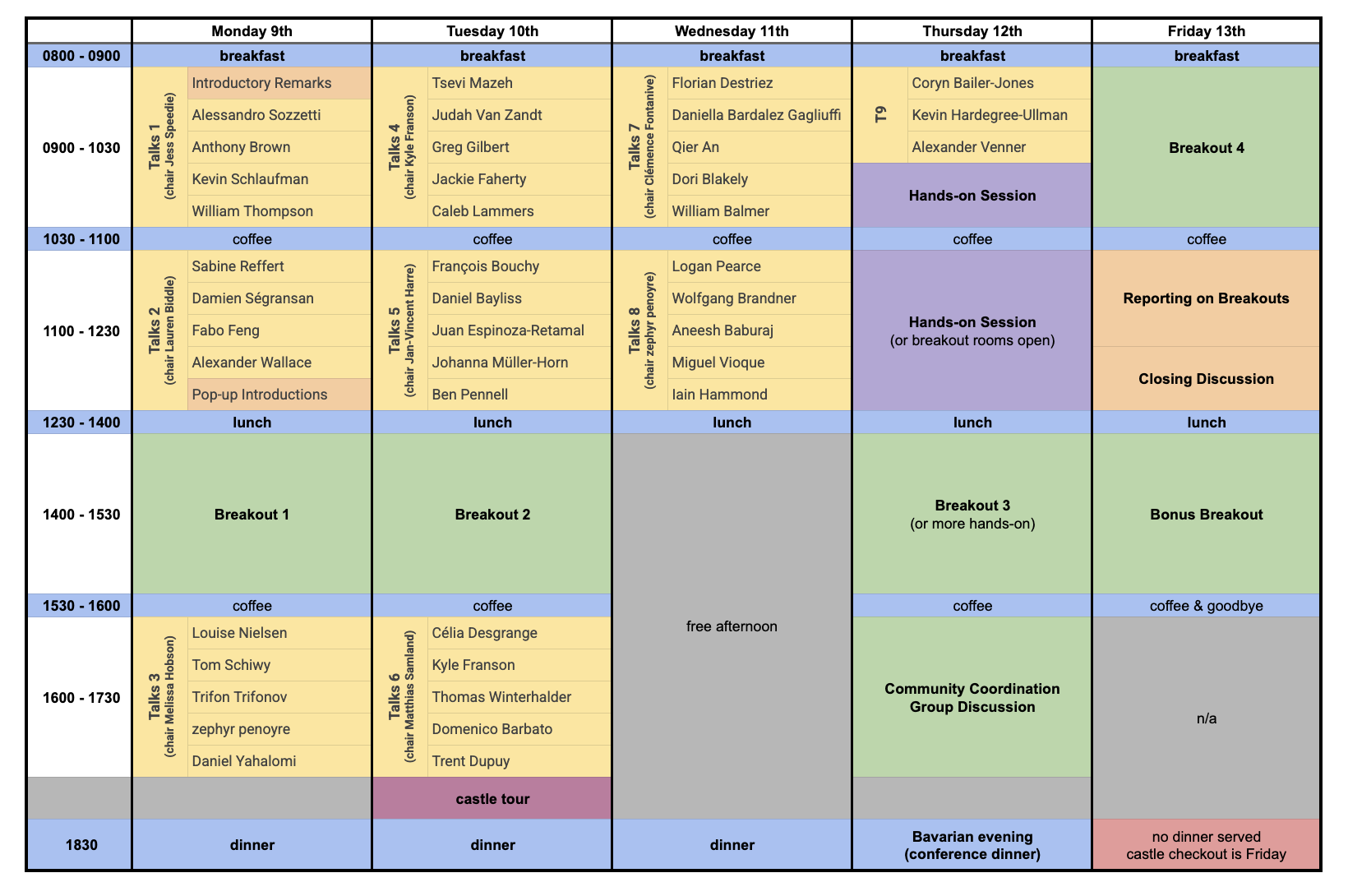
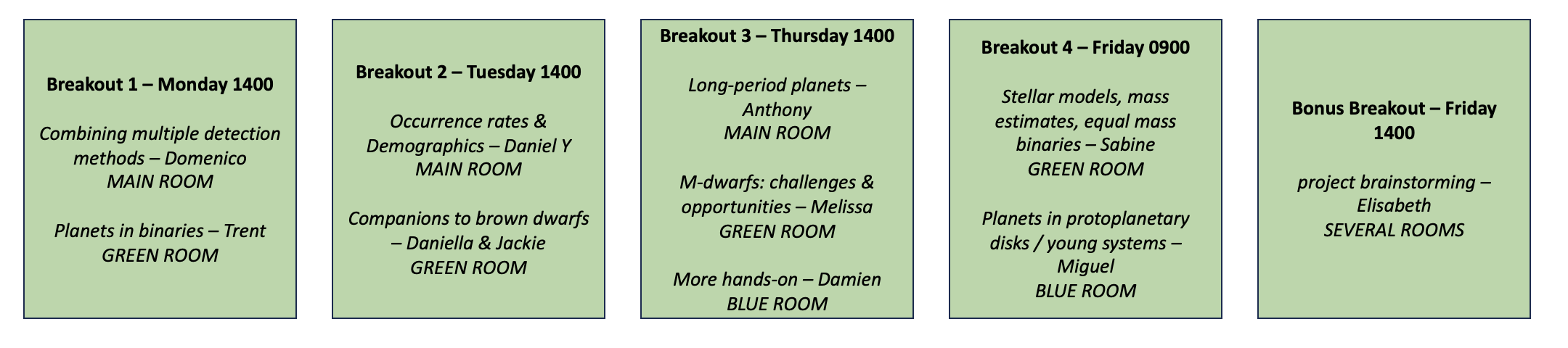
Confirmed participants: Alessandro Sozzetti, Alexander Venner, Alexander Wallace, Aneesh Baburaj, Anthony Brown, Ben Pennell, Caleb Lammers, Célia Desgrange, Clémence Fontanive, Coryn Bailer-Jones, Damien Ségransan, Daniel Bayliss, Daniel Yahalomi, Daniella Bardalez Gagliuffi, Domenico Barbato, Dori Blakely, Elisa Haas, Elisabeth Matthews, Fabo Feng, Florian Destriez, François Bouchy, Greg Gilbert, Iain Hammond, Jackie Faherty, Jan-Vincent Harre, Jess Speedie, Johanna Müller-Horn, Juan Espinoza-Retamal, Judah Van Zandt, Kevin Hardegree-Ullman, Kevin Schlaufman, Kyle Franson, Lauren Biddle, Logan Pearce, Louise Nielsen, Matthias Samland, Melissa Hobson, Miguel Vioque, Qier An, Sabine Reffert, Thomas Winterhalder, Tom Schiwy, Trent Dupuy, Trifon Trifonov, Tsevi Mazeh, William Balmer, William Thompson, Wolfgang Brandner, zephyr penoyre
The workshop will take place at Ringberg Castle, Bavaria, Germany, which overlooks the scenic Tegernsee. With space for roughly 50 participants on a secluded mountaintop, Ringberg is a cozy spot conducive to vibrant scientific discussion, brainstorming new ideas, feasting and merriment, and (if you dare) four-person chess. The full address is as follows:
Tagungsstätte Schloss Ringberg
Schloßstraße 20
D-83700 Reitrain
Bavaria
Germany
The workshop will start at 09:00 on Monday, March 9th 2025, and finish at 16:00 on Friday, March 13th 2025. A full program will be available in due course
While there is no registration fee for the workshop, participants are responsible for their room and board at the castle. Due to the nature and style of the workshop, participants are expected to attend for the full week. The cost will be ~€850, which will include lodging and all meals and coffee breaks, as well as a workshop dinner on Thursday 12th March. Breakfast, lunch, dinner and coffee are provided on-site.
Please note that dinner is not served on Sunday or Friday.
We are committed to providing an accessible environment for all participants. Ringberg is wheelchair accessible (see this page for more detailed information). If you need help or any other special arrangements, please don't hesitate to contact the organizers at gaiaexo2026@mpia.de.
We recommend flying to Munich Airport (MUC), as this is the nearest international airport to Ringberg. The easiest way to get to Ringberg from MUC is by train. Starting at Munich Airport, take the regional train (S-Bahn) line S1 or S8 to Munich Central Station. From Munich Central Station take the train to Tegernsee Station, and then a Taxi (see below). The total travel time from MUC to Ringberg Castle is around 2hr.
The nearest train station to Ringberg is Tegernsee Station. From Tegernsee, you will need to get a taxi to the castle, which is a 15min drive away.
You can find train travel times by visiting the Deutsche Bahn (German rail) webpage. Train tickets can be bought on the Deutsche Bahn website in advance but we don't recommend the cheaper "saver" tickets as these apply to a specific train – you cannot use them on a different train if you have flight delays.
Given the number of attendees arriving at the same time, a taxi reservation in advance via email is mandatory (Taxi Jasinski, taxi-jasinski@live.de). Nearer the event start date, we will share a spreadsheet for coordinating taxis between those who may be arriving/leaving at the same time.
If you decide to rent a car and drive, you can follow the directions on the Ringberg website. Please bear in mind that depending on the snow conditions, you may need snow chains or a four-wheel drive vehicle. Car parking at the castle is free, and does not need to be pre-booked.
You may need to apply for a visa to enter Germany. See here for visa requirements. Feel free to contact the organisers if you need a letter of support.
Note: The visa regulations have changed for those travelling from many countries (including the US and UK) to the EU. For more information, see the ETIAS website.
During the workshop, we require participants to follow the code of conduct for the workshop which can be found below. If you have any questions about the workshop, you can reach the organizing committee.
The organizers are dedicated to providing a harassment-free conference experience for everyone, regardless of gender, gender identity and expression, age, sexual orientation, disability, physical appearance, body size, race, ethnicity, religion (or lack thereof), or technology choices. We do not tolerate harassment, abusive behavior, or intimidation of conference participants in any form. As such, we follow the European Astronomical Society Council (EAS) Ethics Statement and Guidelines for Good Practice and expect all participants to read and abide by their statements.
In addition to a general Code of Conduct and Ethics, all participants must agree with our collaboration policy: that is (1) to openly share their ideas, expertise, and interim results and (2) to respect the sensitivity of in-progress results that are shared at the conference. Participants are encouraged to discuss on-going projects, to change gears, and to start new collaborations. Any participant contributing significantly to a project can expect appropriate credit vessels (e.g., co-authorship).
We pledge to help the entire community follow the code of conduct, and to not remain silent when we see violations of the code of conduct. We will take action when members of our community violate this code such as notifying a workshop organizer or talking privately with the person. This code of conduct applies to all community situations online and offline, including the conference itself, mailing lists, forums, social media, social events associates with the conference, and one-to-one interactions.
Participants asked to stop any harassing behavior are expected to comply immediately. Attendees violating these rules may be asked to leave the event at the sole discretion of the conference organizers.